Purpose and audience
This framework is designed to support senior leaders at second tier within local government typically directors, assistant directors and equivalent system leadership roles who are responsible for leading services, shaping place, and working across complex political and organisational boundaries.
It is intended to be actively used, not just read. The framework supports:
- second tier officers in reflecting on and developing their leadership
- HR, organisational development and learning and development teams in designing development programmes, talent pathways and succession planning
- current and aspiring leaders across the sector to reflect, build capability, and proactively shape their career pathways
- learning providers in aligning content to the real demands of local government leadership roles
- chief executives and statutory officers in supporting, challenging and growing their leadership teams
- the wider system (partners, regions, combined authorities) by strengthening leadership capacity across place.
At its core, the framework describes what good second-tier leadership looks like now and in the future, and how leaders can continue to develop in role.
The design and development of the framework
This framework build on earlier research and development work, including 1:1 interviews and focus groups with senior leaders, evaluations of existing leadership programmes, desk-based research, pilot sessions, and further consultation with practitioners and learning providers from across the public sector.
We have engaged with partners from across the wider public sector, including other place-based systems, professional bodies and leadership development organisations to test assumptions, sense-check relevance, and ensure the framework reflects shared leadership challenges and expectations beyond local government alone.
This work draws particularly on the Local Government Chief Executives’ Development Framework, the Solace Total Leadership Programme, the Solace Behaviours Framework, and 21st Century Public Servant Revisited (see Appendix).
The framework has been designed to translate this evidence into a clear, practical and usable development aid specifically for second tier leaders. It reflects the real complexity of second tier roles, balancing place leadership, organisational leadership and personal leadership. It recognises both formal authority and influence without authority, supports leaders to operate confidently in political, financial and ethical contexts, and separates development of the individual from development of the role, while recognising the interaction between the two.
The framework is intended to be flexible, adaptable to local context, relevant across different council types and geographies, and capable of being used over time rather than as a one-off intervention.
What this framework will be used for
This framework will continue to develop, and can be used in several practical ways: Individuals can use the framework for:
- self-reflection and self-assessment against the eight themes
- identifying personal strengths, development priorities and learning goals
- supporting career planning and progression towards chief executive or system leadership roles.
Chief executives and line managers can use the conversation for:
- structured discussions between second tier officers and chief executives / line managers
- grounding performance, development and wellbeing conversations in a shared language
- supporting coaching, mentoring and peer learning.
Organisations can use the framework for:
- informing recruitment, selection and onboarding for second tier roles
- supporting internal talent pipelines and readiness for future roles and individual career ambition.
The benefits we see in the adoption of this framework from a system leadership and collaboration perspective is how it will provide a shared leadership language across local government partners, align leadership expectations across councils and regions, support collaboration across local authorities, combined authorities and wider systems.
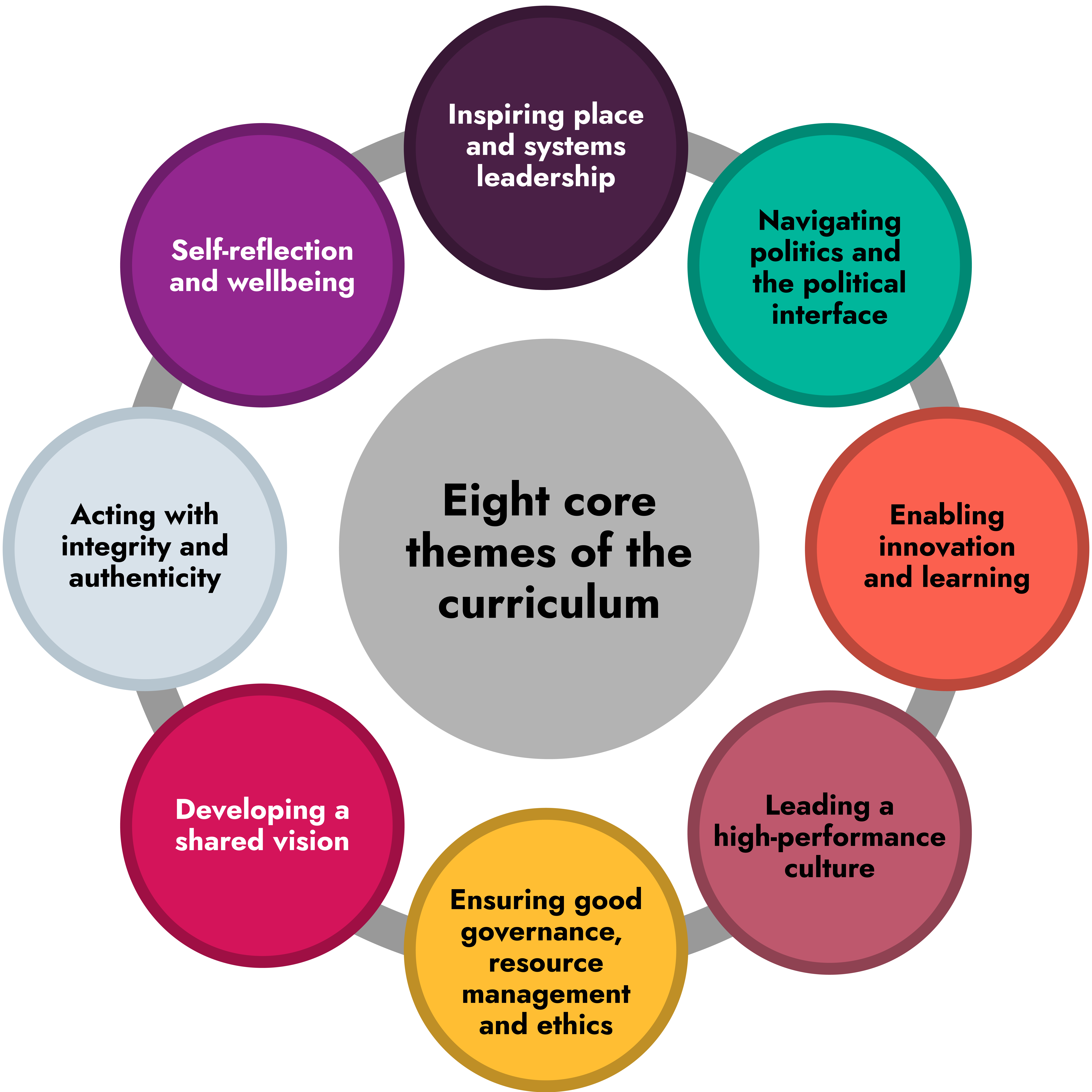
The eight high-level themes
Eight high-level themes have been identified. These describe the core leadership demands of second tier roles.
The themes have been developed further to outline the draft scope of the development framework content.
Inspiring place and systems leadership
- Thinks whole system and long-term, keeping focused on outcomes.
- Builds and maintains relationships of trust across place.
- Seen as a convenor and ambassador of place and uses influencing skills to engage a wide range of stakeholders to contribute and act to ensure sustainable economic growth and wellbeing in communities.
- Understands and reflects how place is changing and inspires people to be ambitious by using an inclusive narrative of place.
- Anticipates and prepares for systemic challenges and is comfortable working within complexity.
- Keeps self and wider organisation focused across place.
Enabling innovation and learning
- Stimulates innovation and creative experimentation to exploit digital technologies to improve delivery of services and support public service reform.
- Creates positive disruption by modelling a positive approach to learning and curiosity.
- Is data curious and digitally comfortable.
- Empowers others, including through delegation.
- Creates a culture where risk is acceptable, within boundaries.
- Brings in learning and ideas from across and beyond the public sector.
- Supports communities to lead change where appropriate.
Leading a high performance culture
- Values and harnesses individual, team and organisation strengths.
- Creates and models a culture of psychological safety and support.
- Takes an inclusive approach to problem solving and decision-making.
- Communicates positive expectations of what people can achieve and ensures people are always clear about objectives and expectations.
- Actively tackles poor performance and inappropriate behaviour.
- Handles conflict between people with sensitivity.
- Supports others in transforming their ways of working to better suit today’s environment.
- Keeps in touch with what’s happening by listening and sharing.
- Communicates in a clear and straightforwardway, whilst using stories to engageand inspire.
- Actively seeks external challenge and benchmarking.
Ensuring good governance, resource management and ethics
- Maintains a strong public service ethos and values including high standards in public life.
- Understands the role of the chief executive and other statutory officers and how to support them.
- Leads the achievement of effective outcomes within agreed resources and in accordance with local constitutional frameworks and policies.
- Provides professional advice effectively to support evidence and risk-informed decision making by members.
- Develops and implements assurance mechanisms to ensure appropriate fiscal control/ compliance, uses GRIP to make sound judgement to make timely decisions.
- Anticipates and mitigates risks, and delivers savings where required to support the council medium-term financial strategy (MTFS).
- Demonstrates ethical leadership and ensures that everyone else does the same.
Acting with integrity and authenticity
- Demonstrates a genuine commitment to providing the best for the community.
- Is confident in speaking truth to power.
- Takes steps to create a fairer and more equitable workplace.
- Actively champions diversity and inclusion.
- Is honest and consistent in behaviour.
- Maintains compassion and composure even in high stress environments.
- Has the tenacity to see projects through even in difficult circumstances.
- Openly admits to failures and learns from them.
Self-reflecting and taking care
- Invites feedback on own performance and that of the organisation.
- Makes time to engage in activities that relate to personal growth and resilience as a leader.
- Undertakes personal development and career planning.
- Has self-awareness about triggers and support mechanisms, eg using peer support networks to help wellbeing.
- Is sensitive to ‘emotional labour’ by recognising the distinctive demands of online, in-person and hybrid working for self and for colleagues and acts accordingly.
Strengthening the leadership pipeline
The Senior Leadership Development Programme Framework sits alongside and builds on the Solace Behaviours and Skills Framework (developed with Real World Group, 2021), which
provides a shared foundation for leadership across public services. The intention is for the two frameworks to work together: the behaviours and skills framework underpins how leadership is demonstrated, while the Senior Leadership Development Framework focuses on what leadership at this level requires.
The Senior Leadership Development Framework aligns with the Solace behaviours and skills to:
- reinforce consistent leadership expectations across the sector
- identify gaps or areas requiring greater emphasis at second tier level
- support self-assessment and reflection through the existing online platform
- support blended learning: programmes, action learning, peer networks, stretch roles.
Building on the earlier work of the Chief Executives’ Development Framework, this framework is the first stage in a potential suite of aids supporting senior officers and is intended to shape future curriculum design and inform pathways for senior leaders below chief executive level. It demonstrates how second tier leaders acquire knowledge, gain experience and sharpen judgement across the full breadth of their role. The framework brings together the core
knowledge, experience and judgement required at second tier and organises these into a set of foundational themes, providing a structured basis for development over time rather than a single intervention.
It is intended to influence recruitment, development and performance management at second tier, support readiness for chief executive and wider system leadership roles and strengthen succession planning across councils and regions.
In time, the framework may also inform development pathways for third tier and head of service roles, helping to address skills gaps and build a coherent leadership pipeline for the future.
Appendix
The development of this framework has drawn on a range of research and sector-led resources. This appendix provides links to the key sources referenced, offering additional context and supporting evidence for the framework.