The framework has been designed to support the local authority, working in partnership with Integrated Care Boards, NHS Trusts and wider partners, to effectively plan, commission, deliver and review Section 117 aftercare.
Forward and Introduction
This framework applies to England only and is intended to support Section 117 aftercare for people of all ages, including children, young people, adults and older adults. It reflects the law as set out in the Mental Health Act 1983 as currently in force. The Mental Health Act 2025 makes further amendments to Section 117, including changes relating to responsible authorities and ordinary residence; not all of those changes are yet in force at the time of publication. This framework will therefore require review and updating as further provisions of the 2025 Act are commenced.
Partners in Care and Health (PCH), with the support of the ADASS Mental Health Policy Network, have developed this Section 117 Aftercare Framework to provide practical support to local authorities, working with Integrated Care Boards, NHS Trusts and wider partners, to strengthen Section 117 governance and practice. Although PCH is rooted in adult social care improvement, this framework is intended to support lawful and effective Section 117 aftercare across all age groups.
The framework has been designed as a suite of inter-related documents, intended to be used together or separately, to support lawful, consistent and person-centred Section 117 aftercare. The framework comprises:
- A Framework for Section 117 Aftercare Guidance, setting out the overarching principles, expectations and core objectives for effective Section 117 aftercare
- Legal frameworks, common challenges and key judgments, providing clarity on statutory duties and relevant case law
- A Section 117 Aftercare Toolkit, with an appendix which includes practical tools and templates that can be adapted by councils, such as assessment and review templates to support consistent and high-quality practice
- Key findings from national engagement with people with lived experience, carers and professionals, capturing learning from those directly affected by Section 117 arrangements.
What is Section 117 Aftercare?
Section 117 aftercare is a joint legal duty under the Mental Health Act 1983 placed on local authorities in England and Integrated Care Boards (as the responsible NHS bodies for the purposes of Section 117) to provide or arrange for the provision of aftercare services for people who have been detained under qualifying sections of the Act.
In England, this duty falls on the relevant Integrated Care Board (ICB) and the local authority. NHS England also publishes rules (NHS England – Who Pays?) to help determine which ICB is responsible for commissioning and funding the NHS element of a person’s Section 117 aftercare.
The duty arises automatically when the statutory criteria are met. In broad terms, this is when a person ceases to be detained under a qualifying section of the Act and the Section 117 duty becomes engaged. In line with the Mental Health Act Code of Practice, Section 117 aftercare also includes people on section 17 leave and people subject to a Community Treatment Order.
The purpose of Section 117 aftercare is to provide or arrange services which:
- meet needs arising from or related to the person’s mental disorder; and
- reduce the risk of a deterioration in the person’s mental condition and, accordingly, reduce the risk of the person requiring admission to hospital again for treatment for mental disorder.
A framework for Section 117 Aftercare
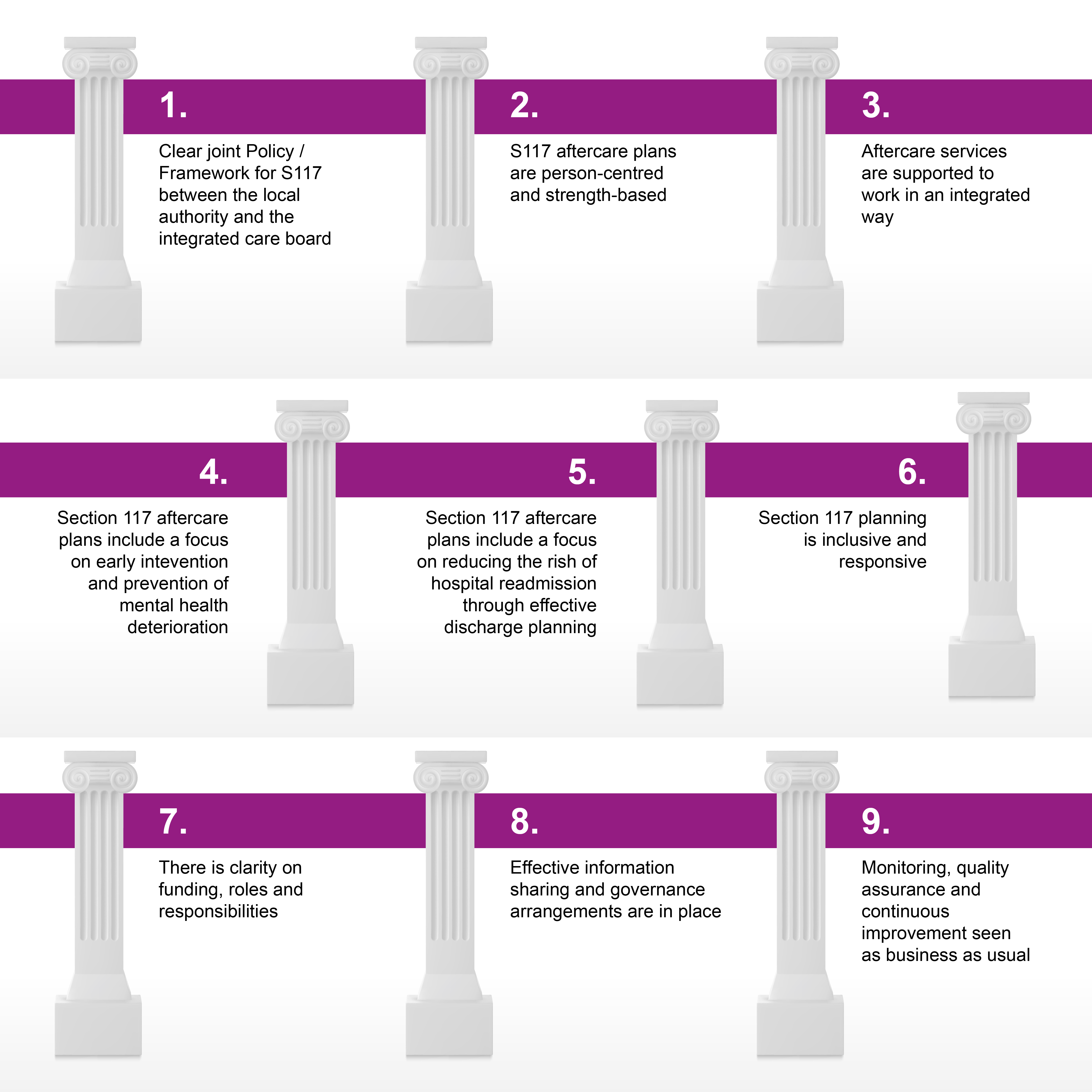
The framework has been designed to support the Local Authority, working in partnership with Integrated Care Boards, NHS Trusts and wider partners, to effectively plan, commission, deliver and review Section 117 aftercare. It is framed around nine interconnecting pillars, which have been developed drawing on the experiences of people who use services and their carers, learning from case law and Ombudsman decisions, and tested through extensive engagement with frontline professionals. Together, these pillars should support lawful, consistent, person-centred and recovery-focused aftercare, ensuring that Section 117 duties are applied fairly, equitably and effectively.
The 9 Pillars for Effective Partnership Section 117 Aftercare
It is framed around nine interconnecting pillars, which have been developed drawing on the experiences of people who use services and their carers, learning from case law and Ombudsman decisions, and tested through extensive engagement with frontline professionals. Together, these pillars should support lawful, consistent, person-centred and recovery-focused aftercare, ensuring that Section 117 duties are applied fairly, equitably and effectively.
For more information on each pillar, click the links below: